Washington may ban sales of farmed octopus

The Washington State Standard is reporting on a new bill, that will outlaw the sale, possession, transport, and distribution of farmed octopus. The bill was sponsored by our own Representative Adam Bernbaum (D-Port Angeles).

The full story is at the link above, but let me just state my support for this bill. In fact, our family stopped eating octopus and squid years ago, and you should consider not eating it as well.

Octopus have been around on this planet for millions of years longer than us. They appear from many studies to show human like traits and exhibet pain and suffering similar to us. The study, found here from none other than the London School of Economics showed distinct traits of sentience in these creatures along with many other similar creatures, i.e. cuttlefish, crab and squid.

I think that we can easily do without these on our dinner plates. I hope you join me and my wife in supporting House Bill 1608 and the previous bill 1153 that outlawed octopus farming in Washington and the new one that ends the economic market for these creatures.

Anji Scalf launches campaign for county commissioner in district 3

Anji Scalf is going to run for Greg Brotherton‘s seat. Anji one of the good ones. She’ll be a great replacement for Greg . Looking forward to supporting her in the campaign.

Navy releases long awaited EIS on Whidbey jets

The U.S. Navy has finally, under court order, released its Environmental Impact Statement (EIS) on the Growler jets at Whidbey Island. As usual, according to the Navy, there is “nothing to worry about. Just go along with our preferred plan.”

You may remember that the Navy was ordered to complete this EIS because of the lawsuit brought against it by the long running court battle between it and the local people who oppose the expansion of the base. The never ending rounds of jets roaring off into the night up to midnight in many cases (I have been kept awake when I lived west of the Jefferson County Fairgrounds many nights in the summer at that time of night), and the unmuffled nature of the jets has been a point of contention for decades. Along with that, poisoning of wells in the vicinity of the bases has been an established fact, as PFAS studies by the Navy showed conclusively. PFAS is the ‘forever’ chemical that is has been found in an enormous array of common items such as food packaging and consumer goods. Twenty states have now banned PFAS. The Navy used fire fighting foam to cool the jets, which has PFAS in it, and that foam leaches into the groundwater over decades. I don’t think I’ve read that the Navy is going to do anything but pay the homeowners, not sure whether the chemical will continue to leach into more wells further afield, or even poison the water supply of the town nearby. But hey, that’s the price the people living near the base have to pay, right?

I have not yet read the full 800 page EIS, but I have in the past on other EIS that they have filled out and won. It’s always the same formula. Multiple choices, including no action, but the Navy action is more jets. Go through some court battles and then the courts cave. Am I cynical? Sure. But we now will await the court’s reaction to the Navy. This is the way the game of environmental protection is played. We usually if not always lose when it’s the military. Given the current administration’s apparent belief that they can create a new Monroe style doctrine, invading South American countries at will for their oil we assume that even more jet pilots are to go and be trained sooner than later on Whidbey.


While on the subject of the use of the Navy in our current military engagement in the Caribbean over Venezuela.

Venezuela is already working closely with Chevron, and has for decades.
Chevron is a major player in Venezuela’s oil sector, operating joint ventures with the state-owned PDVSA, producing significant output (around 200,000 barrels/day, a large chunk of the nation’s total), and exporting crude to U.S. refineries under special U.S. licenses, despite broader sanctions, acting as a vital economic link between the two nations and a stabilizing force amidst geopolitical tensions and U.S. crackdowns on Venezuelan oil flows.

According to the compiled answer by Gemini 3

Key Aspects of Chevron’s Presence:

  • Joint Ventures: Chevron partners with Venezuela’s state oil company, PDVSA, in several projectshttps://finance.yahoo.com/news/chevron-steers-risky-path-oils-143008982.html.
  • Production & Exports: They produce a substantial portion of Venezuela’s oil (around a quarter to a third) and are crucial in getting it exported, primarily to the U.S..
  • U.S. Sanctions Exemption: Chevron holds special licenses from the U.S. Treasury to operate and export, allowing it to navigate sanctions, a policy shift under the Biden administration aimed at fostering political change.
  • Economic Role: Their operations provide much-needed hard currency for Venezuela’s struggling economy and contribute to U.S. energy security.
  • Political Sensitivity: Chevron’s presence is complex, facing scrutiny from both Venezuelan opposition and U.S. political factions, yet it maintains operations by working with the government and benefiting from U.S. policy. 

Recent Developments (Late 2025 Context):

As of late 2025, tensions have escalated with increased U.S. pressure and blockades on Venezuelan oil shipments, putting Chevron in a precarious but central position, as their tankers continue to move oil to the U.S.. (So are we actually seizing our own ships? Author note)

Answer provided by Gemini3


The gunboat diplomacy that the current administration’s is pursuing, which appears to simply be a realigment of American political dominance of Latin American countries (remember United Fruit’s banana empire, our overthrow of the Cuba revolution in 1899, and many other intrigues) alongside the massive funding by the oil companies to our political right, can be easily lead one to conclude we, like many countries, have been overthrown by a consortium of oil companies. Followed by the elimination of wind and EV government funding, there appears to be nothing that the oil cartels of America are not willing to do expand their immense profits.

Back here, we will be looking forward to expansion of jet noise, with no way to demand that we can sleep at night before midnight, nor that our children won’t be impacted for life by the noise that the EIS clearly states is affecting them but is only calling for “more study”. I’ve watched for twenty years as that phrase has been used to slow any attempts at harm reduction by the corporations that have manipulated the process we put in place to protect citizens.

Same as it ever was, but what can you do? Let’s ask Gemini 3 again:

Opposition to jet noise on Whidbey Island centers on the intense, disruptive sound from Navy EA-18G Growler training, leading to health concerns (sleep loss, stress, hearing issues) and legal challenges against the Navy, with groups like Citizens of Ebey’s Reserve (COER) and the Sound Defense Alliance (SDA) pushing for noise reduction, better studies (EIS), and potential relocation, highlighting impacts on over 74,000 residents despite Navy justifications for training. 
Are there alternatives? Sure. It’s right in the EIS. However, the Navy does not want to even consider them. It’s not about “Not in my Backyard” so much as “There are better alternatives that actually are workable, you just don’t want to consider them”.

The people opposing this expansion are Americans and are not opposing the Navy or its mission. We all understand that the U.S. needs a trained military. What we see is an unending appetite to turn the Puget Sound into a training ground for anything the Navy wants. We have the legal right to challenge that. So says the Constitution and virtually all of our judiciary.

You can follow those links above and donate to the fight for our health. Write our state representatives, who do agree with us that the Navy needs to be better regulated on environmental concerns. Reducing the need for oil in your life, using electric vehicles, bicycles etc help push their impact down. But obviously, the Navy is an economic engine, one that is a false economy because it is simply our tax dollars recycled into the Whidbey Island economy, not actual job creation by industry. The belief that the military “produces” anything is simply false. Given that the Navy is being used not for protection but as a tool of an administration that is going to war and committing what many ex-Navy officers have clearly stated are war crimes and doing so without Congress’ approval, we can and should stand up for our rights to “life, liberty and the pursuit of happiness.” It’s easy to define “Life” in that phrase to include our long term health, which produces that life.

New research on wild vs hatchery steelhead

A new study has just come out that helps better understand how to rear hatchery steelhead salmon without impacting genetic diversity, which has been a key concern of wild salmon advocates for years. The findings show that if wild salmon are allowed to spawn naturally, and then the eggs are collected for rearing in a hatchery, that the genetic risks were lessened. This is good news for both sides of the debate, as it shows that hatchery rearing of wild collected eggs may not be a threat to genetic diversity, or at least that’s the way I read it. The authors do state that “…While the longer-term genetic effects were not assessed in this study, other programs have realized reduced genetic diversity during similar timeframes.”


ABSTRACT

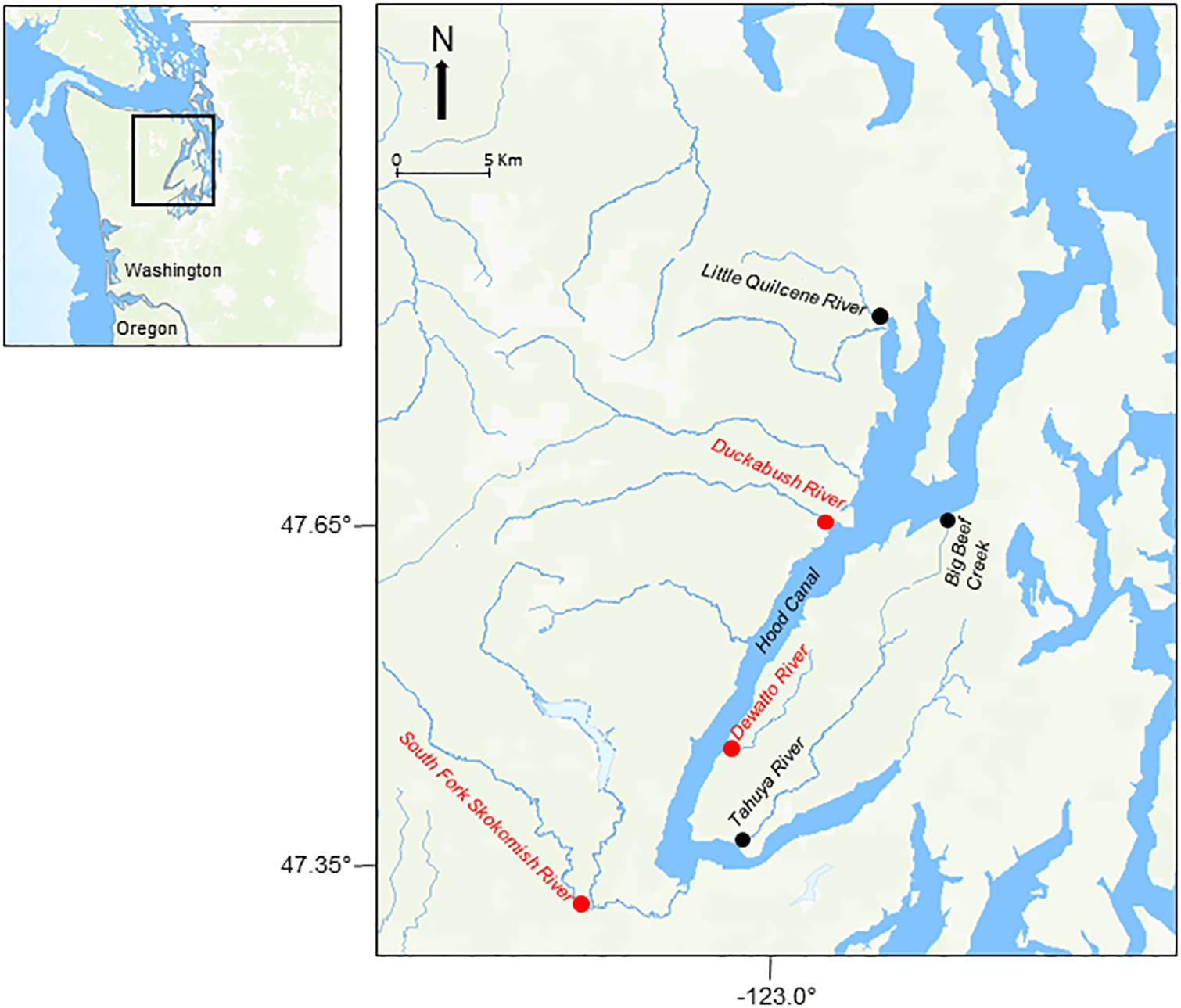
Declining salmonid populations often prompt the use of captive-reared fish to supplement wild stocks, but such programs risk negative genetic and ecological impacts. We evaluated six steelhead (Oncorhynchus mykiss) populations in the Hood Canal watershed, Puget Sound, Washington, including three supplemented and three unsupplemented control populations, over the span of 17 years to assess the effects of supplementation on several population genetics metrics. This program uniquely allowed natural spawning to occur before removing eyed eggs from redds for captive rearing, and later release as smolts or adults. Key genetic metrics—expected heterozygosity, allelic richness, and effective population size—remained stable from before to after supplementation in both the supplemented and non-supplemented populations. Parentage analyses confirmed successful reproduction by captively reared adults after they were released into the wild. These findings suggest that natural spawning prior to captive rearing, among other aspects of the program, lessened the genetic risks typically associated with artificial propagation such as loss of genetic diversity, or a reduction in effective population size. Our results highlight the potential for carefully designed supplementation programs to conserve genetic diversity and maintain effective population sizes in threatened steelhead populations.

Introduction

Supplementation programs, where captive-reared fish are introduced into wild populations to enhance natural production and increase abundance, have been widely implemented as a conservation strategy for declining salmonid populations. However, previous studies have highlighted several potential drawbacks of supplementation efforts, including genetic and ecological risks that may outweigh the intended benefits [17]. Understanding these risks is critical because the long-term success of supplementation programs depends not only on their ability to increase population sizes but also on their capacity to maintain the genetic health of these populations. Careful genetic monitoring is therefore essential to assess the effectiveness of these efforts and prevent unintended harm.

You can read the whole article here:

https://journals.plos.org/plosone/article?id=10.1371/journal.pone.0339458

Northwest just finished warmest fall on record, scientists report and NCAR Research shutdown

The Washington State Standard is reporting that not only did we finish the year with the warmest year on record but our recent rain will not do much to help the ongoing drought in central and eastern Washington. Why? Because it’s falling as rain and not as snow.

This record warm spell includes all temperature data going back to 1880. These floods, this warming, is exactly what scientists have been predicting for decades. Now we reap what we have sown in fossil fuel use. So what is the government doing? It’s shutting down research on the atmosphere.

The Trump Administration has announced the closing of the greatest atmospheric research lab in the world, at National Science Foundation’s National Center for Atmospheric Research (NCAR), the largest federal climate research lab outside Boulder in Colorado. This cynical ploy to rob of us global climate data is directly linked to the fossil fuel industry that underpins this administrations every action. Every drop of gas one buys is funding this destruction of our most valuable commodity, the scientific research to understand the processes of our planet. The announcement was made by OMB chair Russell Voight, the author of Project 2025. His statement said, “This facility is one of the largest sources of climate alarmism in the country…” without providing any evidence except his own opinion.

The Governor of Colorado stated, “Climate change is real, but the work of NCAR goes far beyond climate science,” Polis said. “NCAR delivers data around severe weather events like fires and floods that help our country save lives and property, and prevent devastation for families. If these cuts move forward we will lose our competitive advantage against foreign powers and adversaries in the pursuit of scientific discovery.”

If you supported Trump and the politicians who make up his sycophant society you are helping support these disastrous decisions that continue to destroy our country and turn us into something resembling the Soviet Union or worse. Clearly our Senators and House members do not support this shut down of NCAR Colorado. Is this the kind of country you want to leave to your children and grandchildren?

This is not Making America Great Again, it’s an attempt to create a totalitarian government based on the beliefs of the fossil fuel industry. Better rethink your support of this maniac and act now to stop him before it’s too late. Send your donations to the ACLU and other organizations fighting for out rights. Contact friends in Red states to make sure they have heard this news and tell them to contact their Federal representatives to overturn this insane dictate.

You can support a green economy now by buying or leasing electric vehicles, walking and biking whenever possible, donating to the national organizations fighting the administration in court and supporting local farmers who strengthen our resilience to the effects of climate change .

Our hope is when this administration is finally out of office, that we can rebuild better the destroyed institutions that they have worked to eliminate in the name of the gas station of yours down the street. But that will take more than words on a blog. It takes every one of us doing something to change the direction of this out of control ship of state.

https://www.nbcnews.com/science/climate-change/trump-administration-break-climate-research-center-ncar-rcna249668

Happy Holidays

from the Olympic Peninsula Environmental News

Upper Dungeness River

EVENTS, GRANTS ETC

From Angela at the Puget Sound Partnership’s Strait Ecosystem Recovery Network (ERN)


Here’s the good news in a very soggy week: In less than two weeks, the days will start to get longer! I tell myself this every morning when I open the blinds to darkness. 

In this newsletter, you will find news about funding, volunteer opportunities, events, training and conferences, jobs, and more! As always, we welcome your events and successes for our website and future newsletters:

  • Submit events for the newsletter and our calendar of events HERE
  • Submit your successes so we can celebrate them on our website HERE 

   Funding   

The Puget Sound Partnership (Partnership) gathers public and private funding opportunities in the Recovery Acceleration Funding Tool (RAFT). The National Wildlife Federation hosts a database for Nature-Based Solutions Funding. If you see an opportunity that feels too big to do alone, contact us! Strait ERN can help coordinate and write regional grant applications. The Partnership also has grant-writing assistance available.

Estuary and Salmon Restoration Program Grants – RFPs RELEASED NOV 19th

This grant program, administered by the Recreation and Conservation Office (RCO) provides grants and technical assistance for projects that restore and conserve near-shore areas in Puget Sound. Match requirements have been eliminated for 2026 grants! There are multiple grant areas and application dates vary. Learn more and see RFPs as they are released HERE.

Temper of Times Foundation

Small grants can fund production of advertising or materials and distribution that will lead to measurable outcomes for wildland ecosystem conservation and restoration. Learn more HERE

Date: Proposals due December 15th

MJ Murdock Charitable Trust Strategic Grant Program

The Trust funds conservation, environmental education, natural resource protection, and wildlife preservation projects. The grants can fund capital projects, equipment and technology, or staff. Learn more and apply HERE.

Date: Applications are due December 26th

National Fish Passage Program

This program aims to improve habitat for federal trust species and support infrastructure improvement for communities nationwide. Eligible projects provide benefits to aquatic habitats and infrastructure resiliency. Expected to fund $10M in awards. Learn more HERE.

Date: Proposals due December 31st

Western WA Fish and Wildlife: National Fish Passage Program

This funds projects outside of the Columbia River Basin. Project Summary Forms are due by January 16th. Learn more and apply HERE.

Date: Project Summary Forms due January 16th

Floodplains by Design

Floodplains by Design grants are targeted at reducing flood risks and restoring river functions along Washington’s rivers. The pre-application period for the new grant round opens November 1st and closes January 23rd, 2026. Learn more about the grants HERE.

Date: Pre-applications due January 23rd

Brian Abbott Fish Barrier Removal Board Grants

This grant program supports work to identify and remove barriers for salmon and steelhead migration. Learn more about this program HERE.

Date: Applications due January 26th

ESRP Pre-Design (Learning) Program

Regional Pre-Design (Learning) Proposals support restoration of complex ecosystems or improve effectiveness/efficiency of restoration projects. Learn more about this opportunity and apply HERE.

Date: Proposals due February 9th

Streamflow Restoration Competitive Grants

The application period for these grants will be January 15th to March 17th, 2026. Learn more about the grant program and register for a January informational workshop for applicants HERE.

Date: Applications due March 17th

National Sea Grant Law Center

Letters of Interest for small projects that address legal questions related to ocean or coastal laws. Learn more and apply HERE.

Date: LOIs accepted on a rolling basis through August 1st, 2026

   Volunteer Opportunities   

PSEMP CalendarDo you collect data about the Puget Sound? The Puget Sound Ecosystem Monitoring Program (PSEMP) provides a forum for consolidating data-gathering efforts and conversation. Check out their calendar HERE to see their committee schedules. All are welcome at their meetings!

Stormwater Work Group SurveyThe Stormwater Work Group and PSEMP are collecting information on successes and needs for stormwater monitoring. Fill out the 10-15 minute survey HERE.Date: Survey closes December 17th

Volunteer Your Expertise!

The Habitat Strategic Initiative Lead (HSIL) is seeking input for the updates to the Land Development and Cover Implementation Strategy and the Floodplains and Estuaries Implementation Strategy. You can provide feedback via Google Form: Land Development  |  Floodplains and Estuaries.

Date: Land Development Form closes December 19th

Date: Floodplains and Estuaries Form closes January 9th

Provide Feedback to the Jefferson Land Trust

The Jefferson Land Trust is working on a new five-year Strategic Plan and is seeking community input. Take a 10-minute survey HERE to share your priorities.

   Community Events & Learning Opportunities   

Sequim-Dungeness Christmas Bird CountJoin Olympic Peninsula Audubon Society for their 50th annual Sequim-Dungeness Christmas Bird Count! Track the birds in our neighborhoods. Learn more HERE.Date: December 15th

Wednesday Morning Bird WalksEvery Wednesday, join a band of birders on a 3/4-mile bird survey along the Olympic Discovery Trail. Bring your binoculars and meet in the Dungeness River Nature Center’s parking lot.

Date: December 17th and every WednesdayTime: 8:30 amPlace: Dungeness River Nature Center, Sequim

Native Plant Sale

The Clallam County Conservation District’s Native Plant Sale is currently open for plant orders. See the selection and place your order HERE.

Date: Pre-orders end January 20th

Shoreline Management Act Open House(s)The Department of Ecology is hosting one more virtual Open House to discuss changes to the Shoreline Management Act. Translation services available. Learn more and register HERE.

Date: December 16thTime: 6:00 to 7:00 pmPlace: Virtual; register for link

North Olympic Land Trust’s Open HouseCelebrate NOLS’s 35th Anniversary at their Annual Open House! Enjoy a celebratory slice of cake and swap stories of 35 years of land conservation. Learn more HERE.Date: December 30thTime: 2:00 to 5:00 pmPlace: NOLS Office, Port Angeles

Winter Birding and IllustrationLearn more about the birds of the Salish Sea with the Port Townsend Marine Science Center. Practice scientific illustration, then head outside to look for birds. Learn more and RSVP HERE.Date: January 10thTime: 10:00 am to 12:00 noonPlace: PTMSC Aquarium classroom, Fort Worden

Floodplains and Estuaries LIO/LE Coffee ChatThe Habitat SIL is hosting a coffee chat to talk about the Floodplains and Estuaries Implementation Strategies. This virtual chat is open to members of LIOs and LEs. Register HERE.Date: January 13thTime: 9:00 am to 12:00 noonPlace: Virtual; register for link

Land Development and Cover LIO/LE Coffee ChatThe Habitat SIL is hosting a coffee chat to talk about the Land Development and Cover Implementation Strategies. This virtual chat is open to members of LIOs and LEs. Register HERE.Date: January 15thTime: 1:00 to 4:00 pmPlace: Virtual; register for link

Alternatives to BulkheadsThis self-paced online course is part of Ecology’s Coastal Training Program. Learn about shorelines and stabilization in this 101 offering. Register HERE.Date: January 13 to February 25Place: Virtual

Blueprints for Community-Led Blue CarbonThe focus for this Blue Carbon Collaborative meeting is small-scale blue carbon restoration projects focused on key single-species efforts. Learn more and register HEREDate: February 5thTime: 10:00 amPlace: Virtual; register for link

   Training and Conferences   

Forestry 101 Workshop

Come learn about forest stewardship and health with the Jefferson County Conservation District. Learn more and register HERE.

Date: December 13th

Time: 2:30 to 4:00 pm

Place: Jefferson County Library, Port Hadlock

Roads and Resilience: Integrating State Transportation, Hazards, and Nature-Based Solutions

Join the Shoreline and Coastal Planners Group for a webinar on natural hazard impacts to state roads. Learn more and register HERE.

Date: December 16th

Time: 10:00 am to 12:00 noon

Place: Virtual

NW Land Camp

NW Land Camp brings together land trust leaders and conservation partners for networking and training. In June 2026, Land Camp will be in beautiful Florence, OR. Mark your calendars and watch for more information!

   Jobs   

Natural Resources Program AssistantThe Jamestown S’Klallam Tribe is hiring an administrative program assistant for their Natural Resources Department. Learn more HERE.

LIO Program ManagerThe Puget Sound Partnership is hiring a Local Integrating Organization Program Manager to lead the Partnership’s LIO Program. The position is largely remote, with some on-site work required. Learn more HERE.   News   2025 State of the Sound ReleasedThe Puget Sound Partnership has released the 2025 State of the Sound report. This is an assessment of the results of all our work around the Puget Sound towards ecosystem protection, restoration, and recovery. There is, of course, both celebration of success and the sobering reality of how much more still needs to be done. Read the report HERE.

2024 Puget Sound Marine Waters OverviewThe PSEMP Marine Waters Workgroup has released it’s 14th annual Marine Waters Overview, collecting data from across the greater Puget Sound. Read about and download the report HERE.

New concerns over PFAS in drinking water

Wired magazine has just run a major exposé on ground water contamination with PFAS on military bases and its likely connection to a significant rise in Parkinson’s Disease. This is a story I would highly recommend reading and subscribing to Wired to support their journalism efforts.

New ideas about chronic illness could revolutionize treatment, if we take the research seriously.

https://www.wired.com/story/scientists-thought-parkinsons-was-in-our-genes-it-might-be-in-the-water

Back in 2016, we carried an article about the contamination of groundwater at the Navy base on Whidbey Island.

The Navy did publish the work on testing wells in the areas around the bases.

From the information copied from the links below, it is clear that the Navy was trying to find the level of exposure to PFAS in drinking wells, but it’s important to note that they were not looking for Parkinson’s Disease, only three kinds of cancers: testicular, kidney and prostate.. They do list a comprehensive list of bases where they were testing here: https://media.defense.gov/2020/Mar/17/2002265607/-1/-1/1/SPREADSHEET_OF_INSTALLATIONS_WHERE_DOD_PERFORMING_ASSESSMENT_OF_PFAS_USE_OR_POTENTIAL_RELEASE.PDF

Follow the story:

From the web: https://www.hillandponton.com/toxic-exposure/naval-air-station-whidbey-island/

Whidbey Island Water Contamination 

Naval Air Station Whidbey Island has been identified as a significant source of PFAS (per- and polyfluoroalkyl substances) contamination in the surrounding communities. These “forever chemicals,” which have been used in industry and consumer products since the 1940s due to their resistance to grease, oil, water, and heat, were present in the Aqueous Film Forming Foam (AFFF) used for firefighting and training purposes at the base. 

Beyond PFAS contamination, Whidbey Island’s groundwater faces other threats including potential saltwater intrusion and nitrate runoff from fertilizers, animal waste, and septic systems, prompting increased focus on testing the island’s wells. 

PFAS Contamination

In early 2017, testing by the U.S. Navy near NAS Whidbey Island revealed PFAS levels above the EPA’s lifetime health advisory level of 70 parts per trillion (ppt) PFOA/PFOS. One well showed contamination as high as 2,516 ppt, more than 35 times the advisory level. A more recent Navy sample taken in 2022 showed a certain cancer-causing particulate in drinking water at levels 30,000 times higher than what the EPA considered safe. 

The Navy is currently conducting investigations at multiple locations including the Area 6 Landfill, Ault Field, OLF Coupeville, and Seaplane Base.

291 wells have already been tested near Ault Field, Area 6, and Coupeville. The Navy reported 18 contaminated wells, though it’s unclear how many homes these wells served and there may be many other drinking water sources likely to be contaminated. 

To-date, the Navy has sampled over 360 private drinking water wells near NAS Whidbey Island Area 6 Landfill, Ault Field, and OLF Coupeville. Of these, certain PFAS have been detected at or above the DoD PFAS interim action levels for PFAS in private drinking water wells in over thirty drinking water wells. 

PFAS exposure has been linked to various types of cancers and serious health issues, raising significant public health concerns for residents in the affected areas. If you developed a medical condition after living or working at or near NAS Whidbey Island, you may be eligible for compensation. Get a free case evaluation here to explore your legal options. 


Wired story documents the first major study that showed that bases without PFAS in their water supply had dramatically lower case’s of Parkinson’s than those that did.


Camp Pendleton, in Southern California, is the Marine Corps’ West Coast equivalent to Lejeune. Thousands of young, healthy Marines shuffle through its barbed-wired gates each year. But Pendleton has one thing Lejeune does not: uncontaminated drinking water.

When Goldman compared both populations, the results were shocking: Marines exposed to TCE at Lejeune were 70 percent more likely to have Parkinson’s than those stationed at Pendleton. And in a follow-up study last year, he showed that disease progression in Lejeune vets with the highest exposure to TCE was faster than those with low or no exposure, too. In the world of Parkinson’s research, Goldman’s study was a blockbuster.

The military has been downplaying and lying to us for decades about health issues. Was it that they knew how harmful above ground nuclear testing was, or agent orange, or the burning of toxic wastes in the field in both Gulf Wars, and now PFAS that could be the root cause of a massive increase in Parkinson’s especially among members of the military who lived on some bases.

We may never know how widespread the plume on Whidbey was, nor how many people who lived near the base or in the Oak Harbor area and were exposed to PFAS and developed Parkinson’s Disease. Read the article in Wired to learn the whole story.

If you subscribe to Apple News you can read it as part of your subscription. Also your local library probably has an issue. Or you can buy it on a newsstand, like at airports.

https://pacific.navfac.navy.mil/Facilities-Engineering-Commands/NAVFAC-Northwest/Our-Services/Environmental-Stewardship/Environmental-Restoration/PFAS-Groundwater-and-Drinking-Water-Investigation/Naval-Air-Station-Whidbey-Island

Military accepting public comment on environmental impact statement

here we go again…thank you for the Peninsula Daily News for covering this story. The whole story link is found at the bottom of this article.

While I normally in the past would’ve suggested you send in your comments, it’s been my experience that the Navy takes them says thank you very much and then totally ignores them. The only thing that stops them are court orders, but send your comments in nevertheless. It might be useful in court.


SILVERDALE — The U.S. Navy and U.S. Coast Guard are accepting public comment regarding the environmental impact of at-sea military training activities through Jan. 19.

The services are jointly preparing a supplement to the 2015 Northwest Training and Testing (NWTT) final environmental impact statement (EIS) and the 2020 NWTT final supplemental EIS to assess the potential environmental effects associated with continuing at-sea military readiness activities, according to a press release from Navy Region Northwest.

At-sea military readiness activities include training, research, development, testing and evaluation activities, and range modernization and sustainment.

Those activities would occur on and beneath the water surface and in the airspace within the study area.

The study area, which does not include any land or overland airspace, consists of areas offshore of the Washington, Oregon and Northern California coasts, inland waters of Washington and the western Behm Canal in Southeast Alaska.

Comments may be submitted via the project website at www.nepa.navy.mil/nwtteis or by mail to: Naval Facilities Engineering Systems Command Northwest; Attention: NWTT SEIS/OEIS Project Manager; 1101 Tautog Circle, Room 102, Silverdale, WA 98315-1101.

Read the rest of the story in the Peninsula Daily News today at the following link. please subscribe to the Peninsula Daily News to support local journalism like this .

https://www.peninsuladailynews.com/news/military-accepting-public-comment-on-environmental-impact-statement/

Update on Sen. Murray’s Wild Olympics Bill Advances Through Senate Hearing

Senator Murray’s Wild Olympics Bill Advances Through Senate Hearing on Wave of New Sportsmen Endorsements Calling for Permanent Protection of Wild Olympics.

from the Wild Olympics Coalition:


Dear Wild Olympics Supporter, 

We’re excited to share the great news that Senator Murray’s Wild Olympics bill advanced through a key senate hearing this week on a wave of new sportsmen endorsements who sent a letter to the Committee calling for swift passage of the Wild Olympics Act. This brings the total number of Sportsmen endorsements backing Wild Olympics to nearly 40. The successful hearing is a testament to the fact that your calls, letters, emails and social media posts continue to power the Wild Olympics forward. But above all it’s a testament to Senator Murray’s tenacity and her commitment to getting her and Representative Randall’s Wild Olympics Wilderness & Wild & Scenic Rivers Act across the finish line this congress. So please take a moment to like her facebook post on the hearing and thank her in the comments for fighting to protect the Wild Olympics, and then read her full press release on the successful hearing at the bottom of this email below. 

Washington, D.C. —  Today, U.S. Senator Patty Murray (D-WA) advanced her Wild Olympics Wilderness & Wild and Scenic Rivers Act through a hearing before the Senate Energy and Natural Resources Public Lands Subcommittee, a key milestone in the legislative process toward becoming law. The hearing came after a wave of new endorsements from sportsmen organizations—including the Washington Chapter of Backcountry Hunters & Anglers and the Washington Council of Trout Unlimited—who sent a letter urging the Committee to pass Wild Olympics to protect hunting, fishing and salmon streams for the future against the increasing threats to public land. The new endorsements bring the total number of sportsmen organizations backing Wild Olympics to nearly 40.The Wild Olympics Wilderness & Wild and Scenic Rivers Act, which Senator Murray reintroduced in May with U.S. Representative Emily Randall (D, WA-06) would permanently protect approximately 125,000 acres of Olympic National Forest as wilderness and 19 rivers and their major tributaries—a total of 464 river miles—as Wild and Scenic Rivers. 

“The movement behind our Wild Olympics legislation continues to grow year after year thanks to the tireless work of our coalition of sportsmen, conservationists, Tribes, businesses, local leaders, timber communities, shellfish growers, and so many others,” said Senator Murray. “Today’s Senate hearing is a significant step forward for our effort to permanently protect key areas of the Olympic National Forest—a crown jewel in Washington state—while preserving world-class recreation opportunities and supporting local economies. As long as I’m in the Senate, I won’t stop fighting to win the support we need to get our Wild Olympics bill across the finish line and protect these treasured areas on the Olympic Peninsula for generations to come.”

The bill’s inclusion in the hearing came after Senator Murray took to the Senate floor in August to block a public lands package that did not include the Wild Olympics bill. On the Senate floor, Murray said about the Wild Olympics Wilderness & Wild and Scenic Rivers Act“It is a carefully drafted, it’s a thoughtful piece of legislation and the grassroots support for this bill has only grown over the years. That is exactly the kind of bill which should be included in a bipartisan public lands package. I would invite the Senior Senator of Utah to visit the land this bill covers to help protect our Olympic National Forest… I hope in the future we can work together in drafting a public lands bill that does include legislation like my Wild Olympics bill.” Video of Senator Murray’s remarks on the Senate floor is HERE.

Designed through extensive community input to conserve ancient forests and pristine rivers, protect clean water and salmon habitat, and enhance outdoor recreation, the Wild Olympics Wilderness & Wild and Scenic Rivers Act would set aside the first new wilderness on Olympic National Forest in over four decades and the first-ever protected wild and scenic rivers on the Olympic Peninsula. With a strong foundation of overwhelming local support, the bill has made steady progress each successive Congress—passing the House with bipartisan support twice before and passing out of the Senate Energy and Natural Resources Committee last Congress for the first time in the bill’s history. 

“The forests, rivers, and wilderness of our region shape how we live, work, and play. And for communities around the Olympic Peninsula, access to these resources can make or break local economies,” said Representative Randall when the bill was introduced in May. “This bill protects the remote wilderness we treasure while ensuring access where it is essential for livelihoods, recreation, emergency response, and cultural practices. Protecting our natural resources also means protecting local economies, livelihoods, and Tribal Sovereignty. I’m grateful to all who have shaped this bill and Senator Murray for her leadership to secure the future of the community we proudly call home.”

Senator Murray and former U.S. Representatives Norm Dicks and Derek Kilmer spent years gathering extensive community input on the Olympic Peninsula to craft the carefully balanced legislation, which was first introduced in 2012. It would permanently preserve ancient and mature forests, critical salmon habitat, and sources of clean drinking water for local communities, while also protecting and expanding world-class outdoor recreation opportunities like hiking, camping, boating, hunting, and fishing. No roads would be closed, and trailhead access would not be affected.

Senator Murray worked extensively with local and regional timber interests to remove any currently viable timber base from the proposal to ensure the legislation would have no impact on existing timber jobs, as confirmed in a 2012 Timber Impact Study by the respected independent Forester Derek Churchill.

Aberdeen Forest Products Consultant and Former Timber CEO Roy Nott said in his July 10th 2019 testimony before the House Natural Resources Committee, “My own experience as a CEO and Entrepreneur is that our area’s natural treasures—which provide world-class outdoor recreation, clean water and our area’s high quality of living—are what give us a competitive edge over other regions in attracting and retaining the talented people new companies require.  Wilderness and wild and scenic river protections would help protect and grow the local jobs that depend on our ability to compete for talent against other regions, and they would enhance our recruitment efforts as we work to grow new businesses in the future. And as a former Timber Industry Executive, I appreciate that (the) final compromise proposal was scaled-back to ensure it would not impact current timber jobs.” 

Today’s committee hearing came on a recent wave of other new local endorsements also rallying behind the Wild Olympics Wilderness and Wild & Scenic Rivers Act against the backdrop of increasing threats to public land. The new additions bring the total number of local Olympic Peninsula & Hood Canal region endorsements to more than 800 endorsers, including the Quinault Indian Nation, Quileute, Lower Elwha Klallam and Jamestown S’Klallam Tribes; now nearly 40 local sportsmen organizations and fishing guides; the mayors of Port Angeles, Port Townsend, Westport and other local elected officials; businesses and CEOs; farms and faith leaders; conservation and outdoor recreation groups; and many others. Additionally, more than 14,000 local residents have signed petitions in support. 

Below are just a few of many local testimonials in support of the Wild Olympics Wilderness & Wild and Scenic Rivers Act:

Chairman Ron Allen, Jamestown S’Klallam Tribe: “As stated in the Northwest Indian Fisheries Commission’s “Treaty Rights at Risk” report, “Salmon recovery is based on the crucial premise that we can protect what habitat remains while we restore previously degraded habitat conditions.  Unfortunately, significant investments in recovery may not be realized because the rate of habitat loss continues to outpace restoration.  The resulting net decline in habitat demonstrates the federal government’s failure to protect the Tribes’ treaty-reserved rights.”  In an era where we are witnessing unprecedented rollbacks of environmental safeguards on federal public lands, the Wild Olympics legislation would permanently protect some of the healthiest, intact salmon habitat left on the Peninsula. It is our heritage and cultural principles to protect the lands and waters Nature provides, as well as the natural resources she sustains.  Therefore, we do continue to support and urge swift passage of the Wild Olympics Wilderness & Wild and Scenic Rivers Act.” 

Chairwoman Frances Charles, Lower Elwha Klallam Tribe: “The Lower Elwha Klallam Tribe (“Lower Elwha”) strongly supports the proposed Wild Olympics Wilderness and Wild and Scenic Rivers Act. We believe that it represents a fair compromise between potentially competing interests of preservation, economic use, and recreation. This legislation creates 126,600 acres of new wilderness and nineteen new wild and scenic rivers designations in the Olympic National Forest, the Olympic National Park and Washington State Department of Natural Resource-managed land. For Lower Elwha, the most important aspect of these new designations is the increased protection for salmon habitat. And we appreciate that it expressly acknowledges the fundamental interests and expertise of all treaty tribes in the restoration of fish habitat. This is an important complement to our ongoing successes, along with our federal and State partners, in restoring Elwha River fisheries in the aftermath of dam removal.” 

Connie Gallant, Chair, Wild Olympics Campaign (Quilcene): “We are so grateful for Senator Murray and Representative Randall’s leadership at this critical time for our public lands. The local momentum for the Wild Olympics Act has never been stronger and the need for its protections for our ancient forests & salmon streams has never been greater.”  

Bill Taylor, President of Taylor Shellfish Farms (Shelton): “The Wild Olympics legislation will help protect our state’s shellfish industry, including hundreds of shell fishing jobs in Hood Canal alone – and many more in related industries like processing, shipping, and sales. It protects the rivers and streams vital to the health of our hatcheries and to the health and restoration of Puget Sound. Our oyster beds depend on the clean, cold, silt-free water that drains off Olympic National Forest into Hood Canal. Protecting these watersheds allows our industry to grow, expand and continue to benefit the economy and ecology of Washington State.” 

Ashley Nichole Lewis, Bad Ash Outdoors (Taholah), Sportsmen For Wild Olympics and Member of the Quinault Indian Nation: “Wild Olympics protects the Olympic Peninsula’s ancient forests, free-flowing rivers and salmon streams for the future,” Nichole Lewis stressed. “It will protect fishing, boating and hunting access without closing any roads, but it also permanently protects some of the last healthy upstream salmon and steelhead habitat left on the peninsula.” 

State Representative Steve Tharinger, 24th Legislative District (Sequim): “It is easy to see and understand the ecological value of the Wild Olympics idea, conserving clean and free-flowing rivers, but what is sometimes missed is the economic value that maintaining places like Wild Olympics brings by attracting people to the special outdoors of the Olympic region. I want to thank REI and Patagonia for engaging local community leaders like myself to help design the map, and for recognizing that encouraging people to get out and enjoy the special places in the Wild Olympics proposal brings economic benefits to the communities I represent.” 

Fred Rakevich, Retired logger and 49-year veteran of the timber industry (Elma): “I am a retired logger who worked for fifty years in the timber industry. I have also fished and kayaked most of the major rivers in the Olympics. I was born and raised in Grays Harbor, but have traveled halfway around the world. In all my travels, nothing impressed me more than the natural beauty of the Olympic Mountain Range and the clear running waters that begin their journey flowing toward the lands below. Timber is and always will be part of the Olympic Peninsula’s proud heritage. But our ancient forests and wild rivers are the natural legacies we will leave to our children and grandchildren. The bill protects our natural heritage while respecting our timber heritage.”

Casey Weigel, Owner & Head Guide of Waters West Guide Service (Montesano) and member of Sportsmen for Wild Olympics: “Through hard work and our passion for our rivers and fishing, my wife and I have grown our small business enough to be able to help 3 other year-round and seasonal local guides support families, who love fishing just as much as we do. I support the Wild Olympics Wilderness & Wild & Scenic Rivers Act because our rivers and our salmon are our lifeblood and, without them, businesses like ours, the local jobs they support, and the dollars they bring into our local economy would dry up. The Wild Olympics proposal would simply make the current safeguards protecting our rivers on the Olympic National Forest permanent. That’s all it does. It doesn’t change access or cost timber jobs. And if it did, I wouldn’t support it, because my family works in the timber industry. There are many challenges facing our rivers and salmon, with lots of debate and millions of dollars spent trying to help restore clean water and habitat downstream. But one basic, simple piece of the foundation we can put in place now that won’t cost any of us anything, is to permanently protect the healthy habitat on the federal lands upstream against any misguided attempts to develop them in the future. That’s why I am a proud supporter of the Wild Olympics Wilderness and Wild & Scenic Rivers Act. For Our Future.” 

State Senator Mike Chapman, 24th Legislative District (Port Angeles): “I have been very excited about the economic & recreational opportunities Wild Olympics will bring to the Olympic Peninsula. With REI and Patagonia’s support, our corner of the world is now attracting visitors from all over. Wild Olympics is our future, for fresh air, clean water, pristine forests, and future generations!” 

Dave Bailey, former President of the Grey Wolf Fly Fishing Club in Sequim, WA & co-founder of Sportsmen for Wild Olympics“People think that because our salmon streams on Olympic National Forest appear as they’ve always been, that they are safe. Unfortunately, that’s the furthest thing from the truth.  There are determined threats underway to sell-off public land, roll back current safeguards and open these sensitive spawning streams to small hydropower development, industrial clear-cutting and more road building once more.  That’s bad for fish, game, and sportsmen.  This legislation is critical to preserve what we have.” 

Douglas Scott, Owner of Exotic Hikes and The Outdoor Society (Hood Canal): “Outside my door, the river, forests and mountains of the Olympic Peninsula beckon me to hike and climb. In the Northwest corner of the contiguous United States, far from the hustle and bustle of the big cities, our glacial-fed rivers, full of salmon and surrounded by majestic eagles constantly inspire millions of locals and visitors to the region. Each year, over four million outdoor recreation enthusiasts head to the region, hoping to find a slice of natural beauty in pristine forests and impossibly gorgeous river valleys. As an author, tour guide and advocate for the Olympic Peninsula, I have witnessed the importance of nature and outdoor recreation in the Pacific Northwest. Thanks to the support outdoor enthusiasts from all walks of life, passing the Wild Olympics Wilderness & Wild and Scenic Rivers Act will help ensure that even more of the stunning scenery will be protected and accessible for all. I am proud to Support the Wild Olympics. Come visit and fall in love with the beauty of rainforests, wild rivers, and breathtaking adventures and you will too.”

A fact sheet on the Wild Olympics Wilderness & Wild and Scenic Rivers Act is available HERE.

Washington’s last coal power plant will transition to natural gas – Washington Standard

The Washington Standard is reporting on the conversion from coal to natural gas for the Chehalis power plant. The roots of this go back to the 2000s, when People For Puget Sound (I was a board member and lobbied for our legislative priorities) , The Sierra Club and many other environmental groups started lobbying to shut down the plant.

Finally, almost 20 years after we started the efforts we are just now seeing the conversion discussed as happening soon. There was no mention in the article about *when* the conversion would happen, only that it *is* going to happen. The company (a Canadian firm) waited until the very last month of the very last year before they would have legally been mandated to announce the conversion rather than the shut down of the plant. It has to be asked whether or not the Legislature, in their 2011 agreement couldn’t have simply pushed the deadline to 2012 and we could have seen the coal particulate gone 13 years ago? How many more cases of cancer did we see and have to pay for medical bills between then and now? We’ll never know.

Obviously, this shift to natural gas, another fossil fuel, only minimally reduces our need on those fuels or the harm to the environment. It does reduce the particulates in the smoke that causes cancer, but continues to accelerate our slide towards an unstoppable global warming scenario.

Once again, our politicians acted with no urgency, in the benefit of a foreign corporation who exploited their lack of urgency to the last minute they could. Wonder how much lobbying money went to the swing votes in that legislation? Again, who knows. Those politicians are long gone, maybe even to the company itself. It is no wonder that the voters continue to see little value in the political class who seem undermine every effort to protect the environment and take the lobbying money thrown at them by the very people they are supposed to be protecting us from being harmed by their industries.

“And so it goes.” Kurt Vonnegut, Slaughterhouse Five

The future of inner urban and suburban delivery emerges

While it is easy to get depressed by the current fossil fuel funded federal government and presidential positions on transport, the future is arriving, as it usually does, without any help from the powers that be. The rise of the cargo bike portends a future city with far less gas powered delivery vehicles, less air pollution, and a reduction in vehicles on the roads, which likely will make even car drivers happy!

Marlin Holden Walks On

Marlin D. Holden October 2, 1942 – November 11, 2025

Jamestown S’Kallam elder Marlin Holden passed away peacefully at home on November 11th. Marlin was a former Tribal Council member during the incredibly important work that created the Tribe’s first Tribal Constitution in 1975. His work helped the Tribe get federal recognition, a reversal of the mark of shame on our country that negotiated the Treaty with the S’Kallam peoples and other Tribes in 1855. But there was so much more to this man.

Marlin’s heritage was a Northwest mix of Jamestown and Norwegian. His mother’s side of the family traced back through her parents, David and Elizabeth (Hunter) Prince, and he was the great-great grandson of Chief Chetzemoka, the signer of the 1855 Treaty of Point No Point. Marlin was very proud of this fact and felt his life needed to honor that legacy and also the future generations of the Tribe.

While you can find a full official obituary at this link, I want to focus on my experience being a filmmaker who worked with Marlin, and the friendship he and I had starting around 2010.

I met Marlin while filming the documentary “Voices of the Strait”, funded by the Puget Sound Partnership. The goal of the film was to interview people who had been raised and lived their whole lives on the Olympic Peninsula, and have them describe the changes to the environment that they had seen. Marlin was recommended to me as someone that was worth interviewing.

Marlin was a natural storyteller. By his own words, he never was a good reader, a fact he admitted to some laughter at a lecture he gave at the Centrum Writers Workshop one year. But Marlin had many great stories, and they often reflected the tribal worldview of being in touch with nature. I chose his story of two seagulls fighting over a piece of bait as the final word in Voices. When I heard it I instantly knew that it represented exactly the way to end the film on a positive and happy note. You can hear that segment here.

Marlin’s deep voice and commanding presence conveyed an authority. He was also a very deeply religious man. He not only strongly believed in his faith but gave an enormous amount of himself to his Tribe and community.

In his “retirement” he felt the need to honor the tradition of shellfish harvesting, and was very proud of his small allotment of beach in Sequim Bay where he harvested oysters. It was hard work and even as he turned 80 he was still out there, buckets, boots and shovel in hand. He refused any help to carry the heavy full buckets back to his pickup, laughing that it was his only form of exercise.

He also was a founding member of the Tribal Canoe Journey not only training crew and skippering the canoes, but in his later years would be part of the greeting ceremony on the beaches at Fort Worden and Sequim Bay. It was a task of great pride for him. He believed it was a way to help the younger generation focus on their heritage and avoid drugs and alcohol. Marlin knew full well what lay down that road for them, as he had been a correctional officer for the State and befriended many who were behind bars. He worked very hard to reach out to kids who were at risk, and help them find their way into the tribal circle. We often talked about the pain he felt when he would hear of a youth that was arrested for drugs, or one that had died in a car accident. The tribe is small enough that every single lost life is a major tragedy. Marlin felt those losses deeply.

He was incredibly proud of his life with his wife Patty, a nurse and master quilter who ran a “long-arm”in their home outside of Sequim. He would tell me the stories of them running short 3 and 5k runs in their sixties together. His small dog was always nearby when he was at home.

As we got to become friends after the filming of “Voices” he talked to me over coffee one day of how cool he thought it would be if there were films of the Tribes’ peoples harvesting the various natural resources back at the time of the Treaty signing. We discussed making a film that would be a snapshot of the current natural resource usage by tribal members, and I said I was excited to think about doing the project. He helped shepherd the proposal through the Tribal Council, insisting that I should be the filmmaker. Obviously, it was beyond an honor as many native filmmakers existed in the region he could have chosen. We scripted and he insisted on narrating “Treaty Resources”. The film can be viewed at the Jamestown S’Kallam library but the opening sequence is here.


Over the ensuing years I would get an occasional call from Marlin for help with his computer, since he admitted he was a luddite and did his best to get by with them, and we would go out for coffee and a chat every six months or so. Once I called asking to buy a bucket of his clams for a party we were hosting but he insisted on simply giving me two buckets. He would never take my money, even though he was giving up selling it to the restaurants he contracted with in the area. During the canoe journeys I would always swing down to the beach to say hi. I called him in late July but he never returned my call. I wondered if he was ok, as it was not like him to not call back, but forgot to get back to him to try again.

Marlin was one of the generation of Tribal peoples who fought against incredible odds to take back their rightful place in America and especially the Pacific Northwest. He told me of the green cards that the State required for Tribal members to carry to prove that they could legally fish, and how people like himself would sneek around these outrages carried out by the powers in Olympia and elsewhere that wanted to keep them in poverty and shame. He told me that his grandmother insisted that he not speak the S’Klallam language, likely for fear of him being taken to one of the notorious boarding schools. It was a very real concern as we all have found out. But he told me he was sad that he was not taught the language of his ancestors.

I will miss not hearing his booming voice and his hearty laugh over coffee or out at the beach digging for clams. But he and the others of his generation have taken the Tribe to a point of leadership and strength; in its restoration of fishing and aquaculture in the area, the financial strength of their various enterprises and healthcare center that they open to the county residents and many other accomplishments.

Marlin will sorely missed by his family and tribe. It was an honor to have called him a friend.

Copout at COP

The United Nations 30th annual Conference of the Parties to the United Nations Framework Convention on Climate Change (COP30) talks in Brazil ended  Saturday night.  The takeaway is that there is nothing going to be stopping our addiction to fossil fuels. In fact, the dealers of this addictive drug are now running the UN Climate show. 

The solution they come up with is to continue to not talk about the additive drug, nor how to get off it. They will simply send money to the victims of the crime. 

Are you an island nation that has been around for millennia and find yourself sinking out of sight? No worries, we’ll send you billions to move your butts to some other place where you are simply refugees. 

Are you an industrial nation choking in your car and coal pollution? We don’t really care. Fix it yourself or not. 

The U.N. continues to sink into irrelevancy, whether it’s trying to do something about global warming, the Ukraine war, the West Bank violence or the never ending terrorism of the Palestinian movements of Hamas and Hezbollah. As usual, we are all left to solve our problems for ourselves and luckily that does seem to happening without the U.N. in small ways around the globe. China continues to migrate to solar, cities like Paris and London convert inner cities to bike and pedestrian walkways significantly lowering air pollution.

Panama negotiator Juan Carlos Monterrey Gomez railed against the deal in Brazil as COP drew to a close.

“A climate decision that cannot even say ‘fossil fuels’ is not neutrality, it is complicity. And what is happening here transcends incompetence,” Monterrey Gomez said. “Science has been deleted from COP30 because it offends the polluters. – The Associated Press

Here we are, 30 years into COP and we hear this kind of nonsense about the very people who claim to be wanting and in charge fixing this problem. 

The clear takeaway is that we are on our own, and if you live in a place most affected by climate change, you better build your own ark, because no one is coming to save any of us. 

Drought in Yakima Valley Worsens

On the other side of the Cascades the three year drought in the Yakima Valley creates uncertainty and hard decisions

Another good article about the effects of the third worse drought on record. Farming there is going from bad to worse.

https://www.seattletimes.com/seattle-news/climate-lab/yakima-valley-drought-forces-wa-farmers-to-rip-out-apple-trees/

Halibut collapse in the Bering Sea

The Seattle Times has a good article about the recent collapse of halibut in the Gulf of Alaska.

During his career, the fishing has become a lot tougher, and, last year, a fall fishing trip in the Bering Sea was an outright disaster. A once prime area was largely barren of fish. In the few spots where he still encountered halibut, hungry killer whales stripped away most of the catch before he could bring them onto the boat…Halibut now appear to be at, or near, their lowest point of the past century.

If you have noticed that halibut has vanished from local restaurants or the price for halibut has skyrocketed in your local fish mart, this is the reason.

The reasons are not clearly understood but have many possible causes.

Read it and weep.

https://www.seattletimes.com/pacific-nw-magazine/wa-and-alaska-halibut-fishing-crews-see-troubling-signs-in-recent-harvests/

Event: SALMON RECOVERY INTEGRAL TO SAVING ORCAS

PLEASE JOIN US VIRTUALLY

THURSDAY   NOVEMBER 13, 2025  @ 7PM

REGISTER:  PPF@olympus.net

With CHERYL BAUMANN & TARA GALUSKA

Southern Resident Killer Whales which inhabit Puget Sound are one of the most imperiled marine mammals in the world. They are listed as endangered under the federal Endangered Species Act (ESA). A significant cause of stress for Orca is the lack of Chinook salmon, their preferred food source. Their survival is contingent on recovery of healthy populations of Chinook salmon, also endangered and protected under the ESA. So the fate of these iconic Washington animals is intertwined. Hear from two key scientists what is being done to help bring both Southern Resident killer whales and Salmon back from the brink, with a look at Olympic Peninsula salmon populations particularly important for Orca feeding and survival.

Darlene Schanfald, Ph.D.
Protect the Peninsula’s Future

ToxicDocs database of industry documents

From the Press release of Collaborative for Health and Environment.


Greetings CHE Community,

I hope you’re all doing well on this 10th annual Children’s Environmental Health Day! This national observance offers opportunities to raise awareness, celebrate successes, and share new initiatives protecting children’s health.

To mark the day we’re sharing a new collection of articles from leading experts in the latest issue of the SF/Marin Medical Society Journal. See commentary from Dr. Bruce Lanphear,Dr. Anne-Louise Ponsonby, Nse Obot Witherspoon, and others in a special children’s environmental health section of the journal, available now in the CHE Resource Library. See the full list of articles and authors below.

For those in Northern California — there’s still time to get your tickets for our in-person fundraising event on Sunday, October 26 to support our Zero Breast Cancer program! You’ll hear UCSF’s Dr. Kimberly Badal and CHE advisory team member Dr. Ted Schettler discuss cutting edge research on chemical mixtures and breast cancer risk, and enjoy a gorgeous seaside walk along the Bolinas bluffs. If you’re not in California — or can’t make it but would like to contribute — please make your donation here. Many thanks to those who’ve already purchased tickets! 

We hope you can join us for these upcoming webinars:

On Tuesday, October 14 at 11am PT/2pm ET we will host ToxicDocs: A database of once-secret chemical industry documents. The ToxicDocs website contains millions of pages 

dusty pile of paper documents

of industry documents about lead, asbestos, silica, PCBs, and other toxic substances. This collection includes internal memoranda, emails, slides, board minutes, unpublished scientific studies, and other documents that became publicly available through toxic tort litigation. The resource has been tapped by researchers, journalists, and others exploring environmental health risks. In this webinar one of ToxicDocs’ founders, Dr. Merlin Chowkwanyun, will give an overview of this growing dataset, introducing the interface, explaining the technology behind it, and offering a tour of the searchable content. RSVP here.

EVENT: Friends of Ennis Creek walk

Friends of Ennis Creek – Explore and Learn!

October 19 and October 25

We are offering TWO special tours in October. Join us to visit what we call “our last best chance of a salmon stream in Port Angeles.” Please help spread the word. Space is limited, and we got some walk requests at our Forever StreamFest booth last month. Reservations accepted in order received.

Sunday October 19: A walk to Ennis Creek on Robbie and Jim Mantooth’s trails. Visit a magnificent stretch of healthy salmon stream that Robbie and Jim and fisheries experts from the Lower Elwha Klallam Tribe have been restoring and protecting, with help from North Olympic Land Trust. 

Volunteers from Clallam County Streamkeepers will demonstrate some equipment they use as part of regular water monitoring on the stream. And just savor the peace and beauty of the beautiful area! 

Dress to enjoy fall weather, with good walking shoes (expect a short steep bit of trail returning). Even rain is delightful under tree canopy on trails. We can lend out some hiking poles, but if you have them, you might want to bring them.

Time and Directions: 1:00 p.m. Drive to the east dead end of Lindberg Road (first left from Del Guzzi Drive if coming from east, or first left from Golf Course Road from west). Park on Lindberg Road or go under log entry for Ennis Arbor Farm to limited parking area. 

RSVP: Paul Pickett, (360) 359-3435, earthwater@gmail.com

Saturday October 25: A walk to the mouth of Ennis Creek on the Olympic Discovery Trail. Learn about and see first hand the former Rayonier Mill site, where the Department of Ecology is developing cleanup plans. 

Darlene Schanfald, a leader with Olympic Environmental Council and Sierra Club North Olympic Chapter, will tell us about the history of the site and the proposed cleanup. 

We will also learn about restoration possibilities for the mouth of Ennis Creek, a critical part of the site cleanup and rehabilitation. 

Dress to enjoy fall weather – the ODT trail is mostly paved and fairly flat. 

Time and Directions: 1:00 p.m. Take Ennis Street north to the parking area at the end of the street, and meet by gate to Olympic Discovery Trail. 

RSVP: Paul Pickett, (360) 359-3435, earthwater@gmail.com

Goodbye to Bob Lynette

I knew Bob as a dedicated environmentalist who fought to protect rather than just restore. There are so few like him anymore. So many environmentalists have just gone to being restoration specialists and seem to refuse to actually fight to protect the environment. Many have teamed up with the very industries that are continuing to exploit the environment for profit.

From the Washington Wild obit of Bob.